[
]
ISLAMABAD: The Ministry of National Food Security & Research (MNFS&R) has reiterated its strong commitment to the sustainable development of Pakistan’s olive sector, using advanced genetic science and new international partnerships to expand cultivation and improve plant quality.
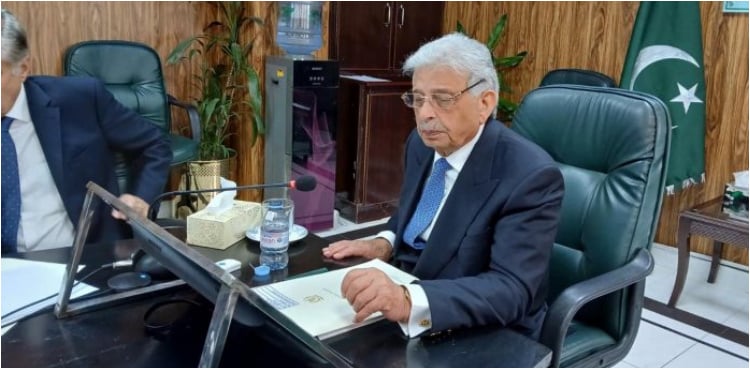
At a high-level meeting in Islamabad, on the Molecular Assessment of True-to-Type Characteristics of Olive Varieties and Olive Sector Development in Pakistan, chaired by the federal minister for national food security, officials reaffirmed their commitment to the sustainable development of Pakistan’s olive sector, describing it as a key part of climate resilience, rural livelihoods and import substitution.
The minister praised the recently held 7th Olive Gala 2025, calling it a milestone in promoting olive farming in Pakistan. He said the government aimed to expand olive plantations in suitable agro-climatic zones while strengthening the entire value chain, from nurseries and orchards to processing and marketing.
During the meeting, officials said Pakistan had already made remarkable progress in converting marginal and uncultivated land into productive olive orchards. The next priority, they added, is improving the nursery system to ensure farmers receive high-quality, true-to-type plants.
A central focus of the meeting was the use of molecular and DNA-based fingerprinting to verify and validate olive varieties. Such techniques, officials believe, would help ensure varietal purity, build confidence among growers and support research and innovation in Pakistan.
The National Institute for Genomics and Advanced Biotechnology (NIGAB) confirmed it has the technical capacity to undertake molecular testing using state-of-the-art facilities, subject to the availability of reference parent material.
In a significant move, the ministry announced plans to deepen scientific collaboration with Italy, one of the world’s leading olive producers. In this regard, the Ministry announced the initiation of a Memorandum of Understanding (MoU) between NIGAB and the University of Bari Aldo Moro, Italy, with facilitation from CIHEAM Bari under the OliveCulture Scale-Up Project.
This collaboration will enable access to internationally recognized molecular (SSR) profiles of olive varieties, provision of parent genetic material, joint research initiatives, and specialized training of Pakistani scientists and technicians.
Italian partners have also offered support in validating Pakistan’s olive genetic resources, strengthening plant certification systems and studying both cultivated olives and indigenous wild species, including Olea europaea subspecies cuspidata.
The minister directed that future plantations be closely aligned with local environmental and climatic conditions. As part of this approach, Tunisian olive varieties suited to hotter climates will be introduced on a pilot basis in the Cholistan region, alongside detailed agronomic and climate studies.
The Ministry also confirmed that Phase-III of the Promotion of Olive Cultivation on Commercial Scale in Pakistan will be formulated and submitted for approval. This phase will encompass innovative financing mechanisms, public–private partnerships, match grant schemes, carbon credit opportunities, and expanded pilot plantations to further accelerate the growth of the olive sector.
[
]
About the Author